Per-unit identity

The life of one box

The name is minted at the door and never changes. Everything around it does — which shelf, whose hands, which order — and all of it is written down against that one name. This is a single unit, end to end.

A-006187 minted on arrival
01 / IN

It arrives

Booked in against its purchase order, with supplier and date. If the maker stamped a serial on it, that's captured. If not, one is minted.

02 / LABELLED

It gets a name

A label prints carrying a barcode, a QR code and a UHF RFID tag — three ways to read the same box, none of them needing line of sight.

03 / SHELVED

It lands somewhere

Scanned onto a bin. The box and the bay are now linked, and that bay stops being assumed and starts being confirmed.

04 / MOVED

It moves. Often.

Every relocation writes a row: out of which bin, into which bin, when, and by whom. However many times it happens, for as long as you hold it.

05 / PICKED

It goes on an order

Scanned off its bin onto a specific order, with the bin recorded at the moment of the pick rather than guessed at afterwards.

06 / OUT

It leaves

Despatched and invoiced. That individual box is tied to that customer and that invoice — permanently, and long after anyone remembers it.

The bin is scanned, not guessed. Location here comes from a person physically reading the bin label and then the stock sitting in it. Not from overhead readers triangulating a room, not from antennas bolted to a forklift, and not from picking whichever shelf marker happened to answer loudest. There's no ceiling hardware to fund, it works the morning you put the first label up — and it produces the one thing the inferred approaches can't: a defensible record of who put what, where, and when. GS1's own vocabulary has a name for the pattern; it's what a location read from a mobile reader is supposed to look like.

Two serials, not one. Where a manufacturer does stamp its own serial on the box, that's captured as well — photographed off the maker's label at pick time and stored alongside ours. Ours makes every unit trackable whether the maker serialised it or not; theirs keeps you tied to warranty claims and the manufacturer's own records.

Movement history

Ask it anything
about a box

Every move ever made sits in one list — nine thousand of them in this warehouse and counting — and every column is a filter. The power isn't the log; it's that you can come at it from whichever end you happen to know.
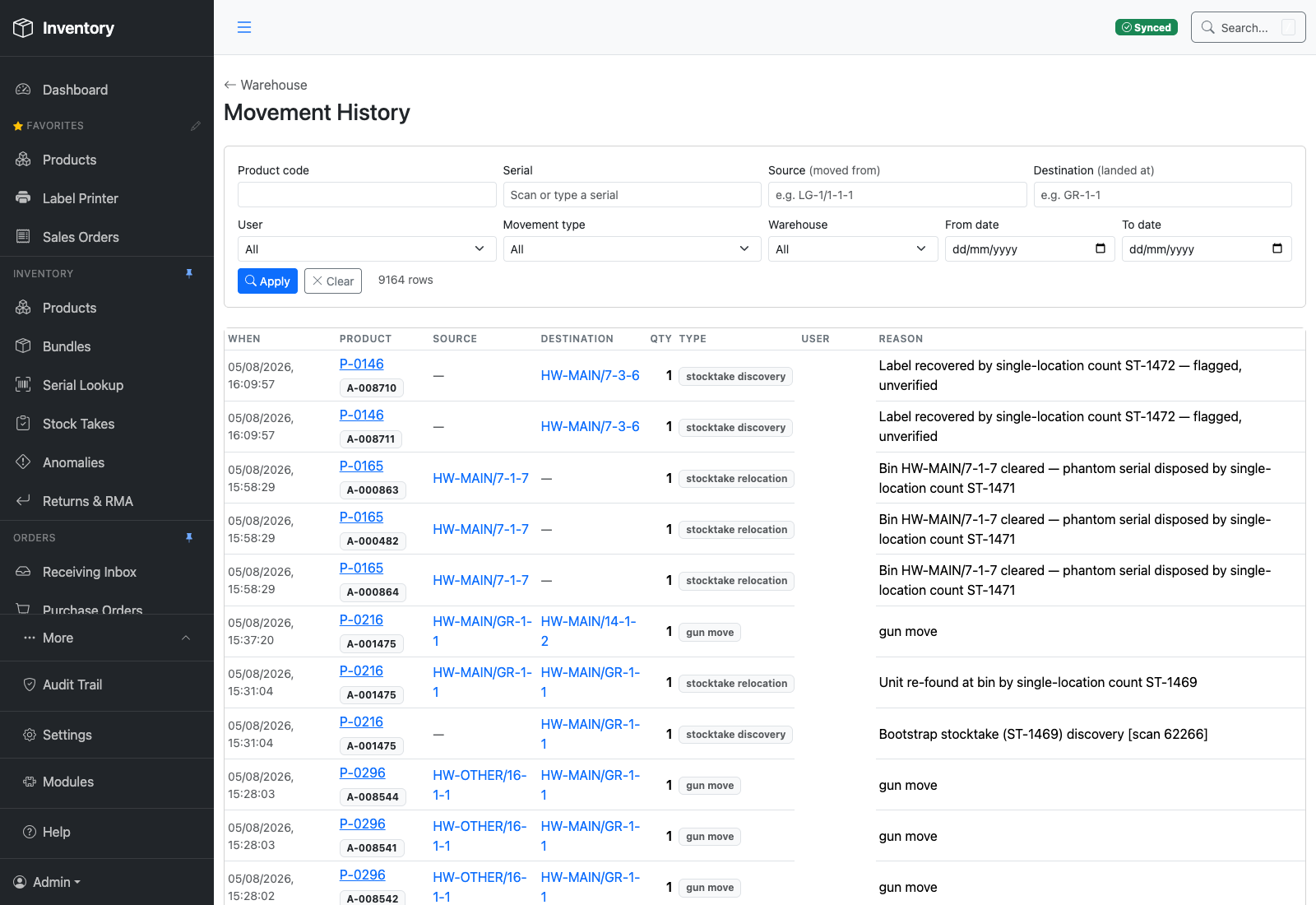
Movement History screen showing filters for product code, serial, source bin, destination bin, user, movement type, warehouse and date range above 9,164 movement rows, each listing the product, its individual serial, source and destination bins, quantity, movement type and the reason it happened
Movement History — every filter above, every move below
Stock takes

A full stock take is a walk

UHF RFID reads every tagged box in range at once — through cardboard, off a pallet, stacked three deep. Counting a bay means walking past it. The count that used to shut the warehouse for two days becomes the time it takes to cover the floor.

THE USUAL WAY

Clipboards and a shutdown

Open the bay, count what's in it, write it down, key it in afterwards. Slow enough that most warehouses do it once or twice a year — and wrong often enough that nobody fully trusts the answer when it comes.

WITH A ZEBRA RFID GUN

Trigger, sweep, next bay

Pull the trigger and the reader picks up every tagged box in range at once. Nothing opened, nothing unstacked, no line of sight. Walk the aisle and the bays count themselves as you pass.

SEEDED

The bay already knows what it holds

Each bay opens on the gun pre-loaded with what should be there, so what's missing and what shouldn't be there both surface while you're still standing in front of it.

RECONCILED

Differences go where they belong

Variances surface for the office to review, and — where you want it — post straight through to your accounts system without anyone rekeying a figure.

SAFE BY DEFAULT

A count never destroys what it didn't see

Not scanning something is not the same as it being gone. Taking stock off a bay needs a deliberate declaration — never silence, and never a half-finished sweep.

Location flags

A shelf can raise its hand

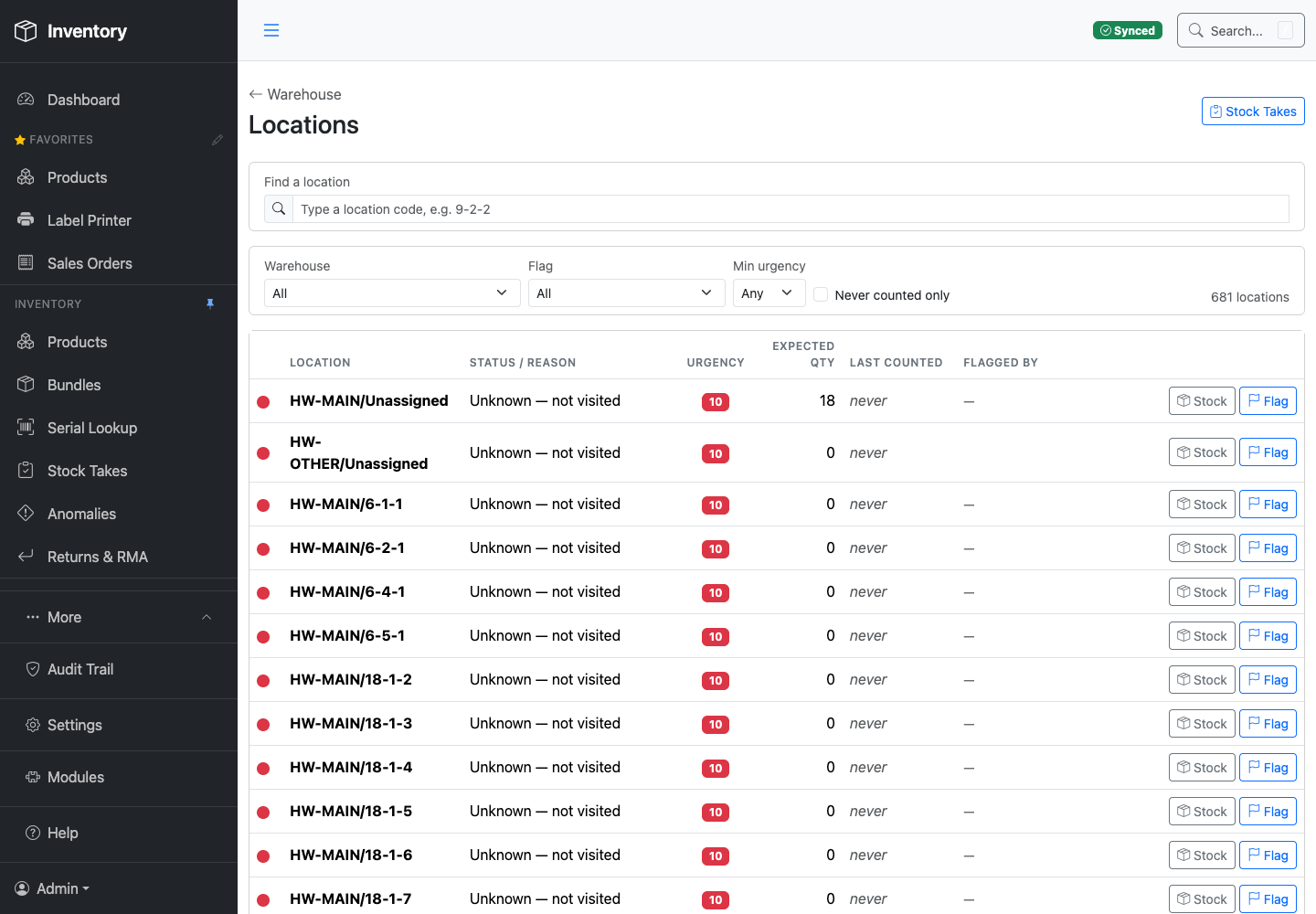
Not everything wrong with a bay is a number. The rack is damaged, the labels have come off, someone has stacked the wrong product behind the right one. Flags let whoever is standing there mark the location itself as needing attention — and turn that into a queue somebody works through later.

  • RAISED THERE

    Flagged by the person who found it

    Anyone with a gun in their hand can flag the bay they're standing at, without stopping what they were doing or finding someone in the office to tell.

  • QUEUED

    It becomes a list, not a memory

    Flagged bays collect into a worklist with a reason, an urgency and who raised it — sorted worst-first, so the round of remedial work is already planned.

  • YOUR REASONS

    Your own flag types

    Alongside the built-in states, you define the flags that match your problems — damaged racking, mislabelled, stock pillaged for parts — each with its own colour and urgency.

  • SELF-CLEARING

    The ones that resolve themselves, do

    Book stock into a bay marked empty and the empty flag lifts on its own. A flag a person raised deliberately stays up until a person clears it.

Locations status screen listing 681 warehouse locations with a coloured status dot, status and reason, urgency score, expected quantity, when last counted, who flagged it, and per-row Stock and Flag buttons
Location Status — filter by flag and urgency, worst first
GET IN TOUCH

Want to see it on your own stock?

Happy to walk through a live warehouse, or run a screen-share against your own product data.

Email us